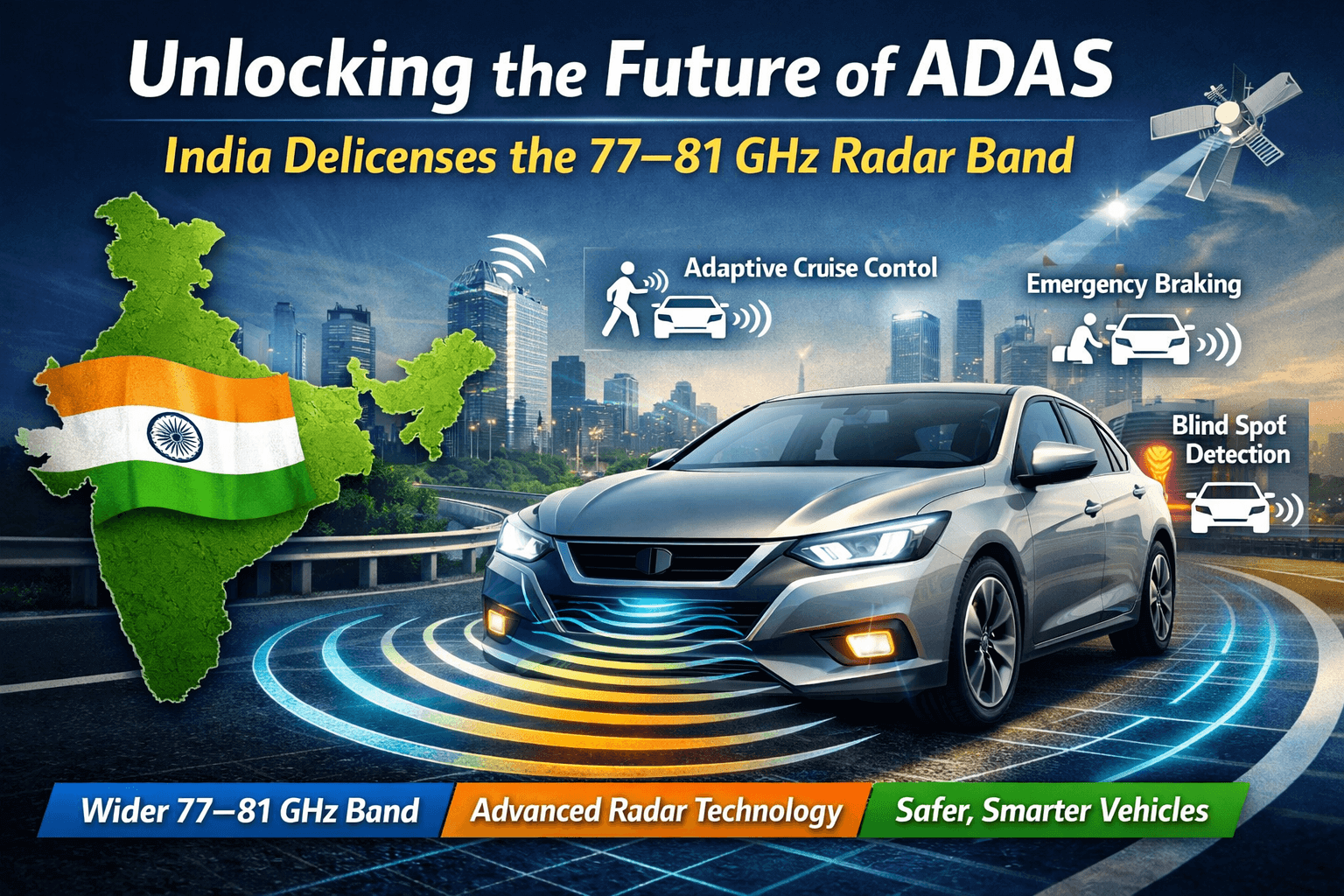
India has taken a major step toward safer and smarter vehicles. In late 2025, the Department of Telecommunications (DoT) officially delicensed the 77–81 GHz frequency band for short-range automotive radar systems. This decision removes a long-standing regulatory barrier and opens the door for faster adoption of modern driver-assistance technologies in India.
What Changed?
Earlier, India allowed license-free use only in the 76–77 GHz band, while the wider 77–81 GHz band required complex frequency permissions. This made it difficult for automakers to use the same radar technology that is already common in Europe, the US, and Japan.
Based on recommendations from the Telecom Regulatory Authority of India, the DoT issued a gazette notification allowing the 77–81 GHz band to be used without individual frequency licensing, as long as the equipment follows the specified technical limits.
This means companies can now deploy automotive radar systems on a license-exempt, shared, non-interference basis.
Why 77–81 GHz Is Important
Modern vehicles rely on radar sensors for Advanced Driver Assistance Systems (ADAS). The 77–81 GHz band provides wider bandwidth, which allows:
- Better object detection accuracy
- Improved distance measurement
- More reliable speed tracking
- Smaller and more efficient radar modules
These improvements are essential for features like:
- Adaptive Cruise Control
- Autonomous Emergency Braking
- Blind-Spot Detection
- Lane Change Assist
- Cross-Traffic Alerts
Impact on ADAS in India
With this change, automakers no longer need to modify global radar designs for the Indian market. This will speed up the introduction of advanced safety features in passenger cars, commercial vehicles, and electric vehicles.
The decision also supports India’s move toward connected and automated mobility.
What About Compliance?
Even though the band is delicensed, approval is still required for the equipment.
Devices must obtain Equipment Type Approval (ETA) from the Wireless Planning & Coordination Wing (WPC).
Manufacturers must ensure that:
- RF power limits are followed
- Emissions stay within allowed bands
- Testing is done in an accredited lab
So while the process is now easier, compliance is still necessary.
Conclusion
The delicensing of the 77–81 GHz radar band is an important milestone for India’s automotive and telecom industries. It aligns India with global standards and makes it easier to introduce modern ADAS technologies.
This move will help make future vehicles on Indian roads safer, smarter, and more advanced.